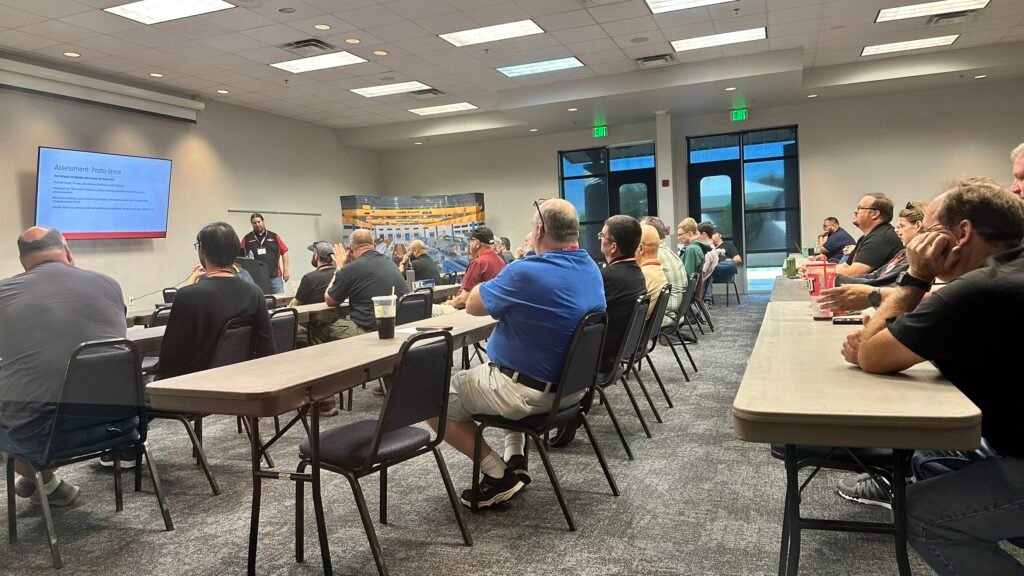
The 2026 Colorado RPM will have three clinic rooms! Please let us know what you would like to hear or what you would be willing to present!
Send your requests or clinic ideas to George Bogatiuk at georgeb@soundtraxx.com
Saturday:
| Presenter | Title | Description |
| Will Hata | L-Gauge Passenger Car Modeling | An overview of passenger equipment modeling in L-Gauge from start to finish. Topics will include prototype selection, digital rendering to test build techniques and concepts, construction methods/part sourcing, lettering/numbering/striping/other similar details, interiors, and completed rolling stock. |
| Doug Junda | the Ibex branch of the Rio Grande in Leadville | One of the lesser know branches of the DRGW: The IBEX Branch. I look at the Ibex branch of the DRGW, that ran out of Leadville to the Ibex Mines. The Branch was the Highest Point reached in the history of the DRGW. The branch started out as narrow gauge and was converted to standard gauge. The history of the branch will be covered as well as some of the history of the Ibex Mining company. I model of the Ibex depot will be on display in S Scale (of course). |
| Scott Chatfield | Bicentennial Locos, the Good, the Bad, and the Ugly | A lighthearted look at how the nation’s railroads celebrated America’s 200th birthday. Runs 48 to 50 minutes. |
| Tony Sissons | Scratchbuilding ProtoType Details- Tools and More | the clinic covering tools, jigs and templates that I (Tony) use covers just about all gauges and interests to potential scratch builders, plus some other odd Railroad Modeling ideas. |
| JT Burke | DCC-Sound Installation Design; see the process from the beginning | From planning to execution, this clinic teaches clean, efficient, dcc-sound installation designing that results in a locomotive that sounds as great as it looks. You will see a variety of sound-installations in older and current locomotives, listen to comparisons of decoder brands and speakers, consider differing decoder formats and more! Whether you’re upgrading older locomotives or customizing new models, you’re bound to gain some new perspective to aiding your dcc-sound endeavors. |
| George A. Bogatiuk | Real Railroad Operations and Using the Sounds of Tsunami2/Blunami to its Fullest! | In this clinic, George will show you how real railroads operate using the locomotives. Then using Blunami (And Tsunami2) he will show you how we can more faithfully recreate the practices used by railroaders, so you get more realism (And fun!) runnign your trains! |
| Andrew MacRossie | Modeling the Colorado and Southern in HOn3: Building a 4×8 Georgetown Loop Layout and Preparing Vintage Brass Locomotives for Operation | The Colorado and Southern narrow gauge lines traversed many iconic sites in Colorado, but none are more recognized today than the Georgetown Loop. In this presentation, I will discuss how I managed to create a condensed version of the Loop in HOn3 scale on a 4x8ft layout. I will also describe how I painted and added DCC to a 50 year old brass C&S locomotive to operate on this “Little Loop.” |
| Nick Santo | “What is a Decoder Buddy and a Power Bridge?” | NixTrainz is the home of the Decoder Buddy. Decoder Buddys are motherboards for diesel and steam locomotives. They hold a 21-pin decoder from any manufacturer. Soldering to a $100+ decoder, choosing and installing resistors for LEDs and separating the locomotive frame from the shell are now problems of the past. Up to 12 lighting functions are available for you to use if your decoder provides outputs. All 12 lighting outputs contained in the shell of the locomotive are separable from the frame via a small connector board. Decoder and motherboard upgrades and conversions from dc to DCC are benefited greatly using a Decoder Buddy. Power Bridges are stay lives that keep your locomotives running smoothly. The clinic will discuss the details and benefits of all the NixTrainz products. |
| Tim Blackwell | Freelance Renaissance from a Publisher’s Perspective | Tim Blackwell offers a publisher’s view of how freelance modeling has evolved from kitbashing roots to today’s ready‑to‑run abundance. He highlights simple, effective modifications and light rebranding that shaped his Whitehurst & Pine Ridge and North Tarrant & Pacific, showing how freelancers can create believable first‑ and last‑mile rail service. |
| Bob Pilk | The Oregon, California & Eastern Railway at the Colorado Model Railroad Museum | Bob Pilk presents the OC&E as a standout example of proto‑freelance operations. He explains how prototype practices, tailored industries, and realistic traffic patterns combine to create a railroad that feels authentic while still allowing creative freedom. A great clinic for modelers exploring prototype‑inspired freelancing. |
| Roger Kujawa | Prototypical Industries on the Atlantic & Great Western | Roger Kujawa examines the industries, commodities, and railcars that generate meaningful traffic on a railroad. He demonstrates how understanding cars and customers builds operational depth—whether modeling a prototype or freelance concept—and how freight flows tell the story of your railroad more effectively than scenery alone. |
| Greg McComas | Golfo y Rio Bravo: A Foreign Freelance Concept | Greg McComas explores the challenges and creative opportunities of designing a Mexican freelance railroad from scratch. He discusses geography, culture, operations, and equipment choices that shape a believable foreign concept, offering practical insight for modelers interested in freelancing beyond U.S. borders |
Sunday:
| Bill Kepner | Unleashing an Army of Arduinos on your Model Railroad | In this clinic we will introduce the concept of Internet of Things as it could be used in Model Railroading. Many modelers have used Arduinos and their friends for everything from simple building light sequencing to complete CTC signaling Systems. Once you’ve programmed the first one, you’ve found you can automate simple things that have enhanced your model railroad. How can you take the next step? Is there simple technology that can be used to get more than one to work together to accomplish something more complex ? Without getting into the weeds, we’ll discuss technologies that make these things happen. At the Colorado Model Railroad Museum, we’ve used MQTT (a message transport system, but MQTT doesn’t stand for anything) to turn on devices around the museum, operate signals, and report problems with power supplies. Combined with WiFi, we don’t have the need to string additional wires around the layout. There will also be a section of other uses of WiFi, such has DCC throttles and streaming video. We also are looking at how Home Assistant might be used. While this session will be more technical that other clinics at the RPM, the material will be targeted at an experienced modeler that has some electrical and computer skills. Maybe you know a little about programming an Arduino, or configuring the WiFi on your laptop or phone. That’s all you will need to get something out of this clinic. |
| Paul Spilman | Showing its the Seventies | In this clinic, we will take a thorough look at some of the freight car details that place it in the Seventies. From changes in consolidated stenciling requirements, to the massive effort tracking down faulty U-1 wheels and the associated little yellow dots, learn how you can narrow down your era to specifically show that you are modeling the 1970s – or even a particular year. |
| Rob o’Neil | Lessons Learned converting a highway reefer trailer into the perfect train room | Using 1:1 scale equipment to house your scale empire. Lessons learned in acquisition, construction, climate control, and layout support. (and why a reefer is MUCH better than a dry box or shipping container) |
| JT Burke | Electronics Soldering; demystified and simplified | Covering equipment (and why one’s equipment may be fighting them), solders and fluxes, temps and cleaning, with slides and short videos demonstrating the techniques discussed. This clinic takes an aspect of the hobby many find frustrating and lifts the veil of difficulty to reveal that it’s quite easy with a thorough understanding of the basic principles and materials. |
| Mikey Inmon | Fire Mitigation and Model Train Layouts | Considering recent publicized events in the Model Railroad press, we will take a dive into some potential causes of fire on our model railroads and how these fires can be minimized and prevented. The second part will cover the fire triangle, the classes of fires, the types of fire extinguishers, and their uses. |
| Cameron LaFleur | Reconfiguring a Locomotive Beltpack for Model Railroading | Discover how a full-size railroad beltpack was reconfigured into a fully functional wireless controller for model railroad operations. This clinic covers the complete process—from planning and electronics to 3D printing, programming, and final assembly—while sharing practical lessons learned along the way. |
| Trev Smith | Freelance That Feels Grounded: Developing a Plausible Concept | Trev Smith explains how to craft a believable freelance backstory using lessons from the evolution of his Ohio & Pennsylvania and the revival of the Cardinal System. He shares practical methods for refining history, purpose, and plausibility so your freelance railroad grows into a coherent, living concept. |
| Scott Thornton | The Paint Creek & Waterville Railway: Inspiration from an Abandoned Milwaukee Branch | Scott Thornton details how an abandoned Milwaukee Road branch in Iowa inspired his compact freelance railway. He discusses local industries, motive power, and his unique “dioRAILma” approach—combining diorama artistry with operational realism—to create a small railroad rich in character and purpose. |
| Shawn Hoppert | Overcoming Analysis Paralysis | Shawn Hoppert shares strategies for breaking free from perfectionism and stalled progress in model railroading. Drawing on his own cycle of restarts, he shows how version 1.0 thinking, small steps, and rediscovering joy can help freelancers and prototype modelers alike finally build—and run—the railroad they imagine. |